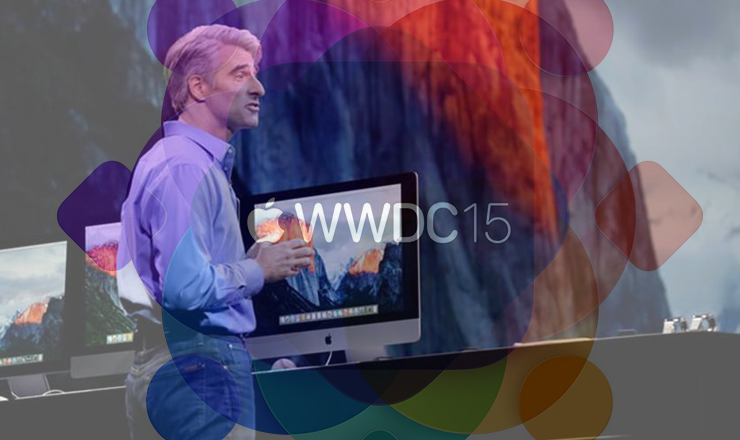
Yep, it’s that time of the year again when Apple holds its annual developer conference and the Cupertino company went full out this year specifically in terms of providing software updates to all of its products. Of course the Mac is the first to get an update with the announcement of OS X El Capitan.


Designed as update to OS X Yosemite, El Capitan (which is named after a rock formation in Yosemite National Park) will provide performance improvements over its predecessor. 

Some of the new features of El Capitan include improvements in Spotlight search with support for natural language queries, multitasking with split-screen views and gesture capabilities in certain apps.

The operating system update will also bring the company’s Metal graphics rendering engine to the Mac. Originally created for iOS, this feature should allow developers to have near-direct access to a device’s graphics hardware, delivering improved performance and a richer graphical experience.


Moreover, Metal will allow OS X to combine the processing power of both the GPU and CPU to improve the performance of apps, which is why software makers such as Adobe will also make use of the API to improve its own products.

Mac OS X El Capitan is now available to developers and there will be a public beta by July, so even ordinary users can try out the OS before its official launch sometime in Q3 2015.

Connect with The Techie Lifestyle on your favorite social networking sites
 
Twitter Facebook Subscribe to RSS Feeds Google Plus Follow via Email

Compared to desktop PCs and laptops, the Apple MacBook Air usually has a smaller storage capacity making it a bit difficult to work with when you’re someone who stores a lot of media files and documents. And although you can use external disk drives to augment the built-in storage in the MacBook, you still need to lug them around if you’re planning to use them.

Adam Elements’ mDrive stealth card gives us a more discrete and convenient option by providing a plug it and forget it storage solution for the MacBooks. Basically, the mDrive stealth card is an aluminum microSD card adapter for your laptop, which uses the MacBook’s card reader to expand storage capacity.

The adapter sports an elegant metallic design that blends smoothly with the look of the MacBook Air. It supports all types of micro SD/SDHC/SDXC cards in a range of capacities. It’s also a plug and play device so users won’t need to install any software or drivers in order to use the device.

The stealth card is available in three different models (103A, 303A and 304A) and also supports the latest MacBook Pro Retina model. You can also use the mDrive as a backup device using Apple’s Time Machine application to protect important data.

The mDrive stealth card will have a price tag of around $20 or a little over 800PHP.

Connect with The Techie Lifestyle on your favorite social networking sites

Twitter Facebook Pinterest Subscribe to RSS Feeds Google Plus Follow via Email

Apple’s annual developer conference may not have a lot of announcements in terms of physical products but it was jam-packed with huge news when it comes to software – after all, it’s still a developer conference.


The first big announcements was Apple’s HomeKit – a communication standard for connecting iOS devices to various home appliances. The wireless protocol is designed to securely connect devices with an iOS-powered device or tablet. At the moment, the protocol has no automation layer yet but according to Apple there are plans to bring this feature into the kit in the future.

But the biggest announcement of the day would definitely be the unveiling of Swift- Apple’s new programming language that promises to deliver apps that run faster and smoother than those made from its predecessor – Objective C.


The new programming language can work alongside Objective-C and C codes in the same app so the transition from the previous codes to Swift won’t be so sudden. For devs who want to learn more about Swift, Apple has published a 500-page guide in its iBook Store, which is already available for download.

Connect with The Techie Lifestyle on your favorite social networking sites

Twitter Facebook Pinterest Subscribe to RSS Feeds Google Plus Follow via Email

Apple’s new patent applications point to the use of quantum-dot technology in order to further improve its retina displays.


According to the US Patent and Trademark Office, the Cupertino company has applied for four new patent that will feature quantum dots in tandem with micro electromechanical systems shutter control to enhance a display’s colour gamut and produce more vivid and clearer images.

There’s also a backlight dimming technology patent that should work hand in hand with the quantum-dots in order to correct any LED colour shift, improving colour accuracy.

As with other patent applications, do take this story with a pinch of salt. However, it’s good to note that such technology isn’t as far-fetched as some may think. Quantum dots are already commercially in use. In fact, Amazon’s Kindle Fire HDX is already using it, so having a quantum-dot laden retina display isn’t the stuff of science fiction.

Connect with The Techie Lifestyle on your favorite social networking sites

Twitter Facebook Pinterest Subscribe to RSS Feeds Google Plus Follow via Email


Another device to get an update in this year’s WWDC is the Apple MacBook Air. The new super-thin notebook from Apple gets an improved set of hardware that enhances its performance and most importantly its battery life.

The new MacBook Air features power-efficient fourth generation Intel Core i5 and i7 processors (previously codenamed Haswell) that give the 13-inch version up to 12 hours battery life (10 hours of iTunes movie playback) and the 11-inch model up to 9 hours of battery life( 8 hours of iTunes movie playback).

Moreover, the new MacBook Air models support 802.11ac Wi-Fi that provides up to three times faster connection speeds when connected to an 802.11ac base station. Also, Intel’s HD Graphics 5000 gives the MacBook Air up to 40 percent faster performance for gaming and graphics intensive apps. There’s also an improved flash storage that is 45% faster than previous generation SSDs and nine times faster than traditional hard drives.
The notebook features dual microphones, a FaceTime HD camera, a high-speed Thunderbolt port and two USB 3.0 ports. The MacBook Air also supports dual displays and video mirroring while simultaneously using full native resolution on the built-in display. The body of the notebook is made from highly recyclable aluminium and comes standard with energy efficient LED-backlit displays that are mercury free and made with arsenic-fee glass.


The 11-inch MacBook Air comes with a 1.3Hz processor with Turbo Boost speeds up to 2.6GHz, 4GB of memory and is available with 128GB of flash storage for $999 and 256GB of flash storage starting at $1199. The 13-inch models on the other hand are obviously a little bit pricier with the 128GB version retailing at $1099 and the 256GB model for around $1299.

Connect with The Techie Lifestyle on your favorite social networking sites

Twitter Facebook Pinterest Subscribe to RSS Feeds Google Plus Follow via Email


Taiwan’s Inhon brings the battle of the ultrathin notebooks to its mainstream competitors with the company’s Blade 13 Carbon.

The Blade 13 Carbon features a 13-inch 1080p HD screen and boasts a slimline frame of just 12.88mm which the company claims to be thinner compared to another ultrathin notebook – the NEC Lavie X. It weights around 1.9lbs (870g) making it a full pound lighter than the Apple MacBook Air.

The laptop will be powered by either an Intel Core i5 or i7 prcoessor, up to 256GB of SSD storage and 4GB of RAM. The Blade 13 Carbon will run on Windows 8 and will retail for around $1350 in Taiwan. There’s also a fibreglass-version with a 1600 x 900 display and will cost around $1000 and weigh an additional 2.6lbs.


No additional information has been provided about its full specs, nor is its international availability. Nevertheless, it’s a good sign to consumers that smaller brands are now coming up with similarly spec’d and similarly designed machines that can serve as a good alternative for more popular and at times more expensive brands of computers.

Connect with The Techie Lifestyle on your favorite social networking sites

2013-2015 © The Techie Lifestyle
Planer theme
Powered by Jasper Roberts Consulting - Widget